Humour, music and literature; a mid autumnal cultural blog....
COMEDY:
On
Saturday October 15th, Shelley and I had a good day out. First up,
we braved wind and unseasonal hail showers to watch Percy Main win 2-1 away to
Ponteland, in the company of pals John (over from county Kildare for the
afternoon; I do not jest), Graham and, briefly, Phil. Following a helpful lift
from Graham and a Metro into town, we enjoyed some absolutely blinding Indian
street food from My Delhi on Clayton Street. Five stunning small plates and
assorted dips and breads for £40, but make sure you book on a weekend, as we
were exceptionally lucky to walk in and get a seat. From there, a quick beer in
the Alpha Delta lounge and then on to the main part of the day; a trip to The
Stand Comedy Club.

I’m
really not sure why, but I’ve hardly ever seen live comedy. I really can’t
believe I’ve never seen Stewart Lee live, but there you go. Hence, when Shelley
expressed an interest in having a laugh on a night out, I readily concurred. Searching
through the listings, I was delighted to see Dave Johns, of I Daniel Blake
fame, headlining on this particular day. Tickets were bought instantly: mind, I
have to say though, at £20 a pop for something that lasted for just over 90
minutes, it isn’t a cheap night out.
As
regular readers know, I’m an ever expanding ball of neuroses and phobias, with
a fear of crowds that gets worse by the year. The fact that The Stand is a
subterranean cavern that was almost sold out on this occasion didn’t do my
anxiety much good, but in the absence of a ready supply of Propranolol, I
girded my loins, took plenty of liquids on board and grounded myself by taking my
shoes and socks off. This relaxed both Shelley and I, allowing us to enjoy an
excellent evening’s entertainment.
The
Stand is a pretty regimented sort of place. They don’t allow big groups of
lads, ban photography and seriously discourage heckling. Perhaps because of
this, I didn’t make enough notes, so missed out on the names of the very funny
compere, who lives in South Shields but comes from Jarrow (“I’ve moved up in
the world to place with only 26% unemployment) or the two supporting acts; a
woman from Kenton who riffed on her anxieties about having a posh boyfriend and
a bloke from Manchester who was the epitome of a head-on collision between
eccentricity and eclecticism. He steered just the right side of being blatantly
offensive. As you’d expected, Dave Johns was great; bearded, bespectacled and
sporting a woolly hat, he certainly wasn’t relying on his looks for laughter. I
laughed out loud, almost continuously, at a seemingly random unconnected series
of random observations that all hung together admirably. In short, a fab night
out, though I don’t think I started breathing properly until I escaped the
depths and stood sucking in lungfuls of High Bridge air.
MUSIC:

The
main event that held my attention in the period since I last wrote about music was
the long-delayed Godspeed You! Black Emperor gig at Glasgow Barras in the
middle of September. Thanks to Dave, who did the driving, and Ben for being
brilliant companions: in Mono for drinks and food as well as on the road
and in the gig; not long until David Gedge in Gosforth eh? Unquestionably, this
latest exposure to GY!BE was an incredible evening, as the venue’s decadent
grandeur and ageing environs added to the atmosphere of surreal, anarchic
degeneration, found in both the music and the visuals. As on every occasion
I’ve seen the impossibly brilliant Quebecois post-rock nonet, the reassuring
hum of Hope Drone hinted at the arrival of the wordless perfection
ahead. There are no words with Godspeed You! Black Emperor because none are
necessary to paint portraits in the air. I’d bought Slow Riot for New Zero
Kanada from the merch stall in advance on the gig, having learned that
neither Moya nor BBF3, the two stunning pieces contained therein,
would be performed this time. I’ve really no idea how I’d not got round to
purchasing this before. Instead, we had most of God’s Pee at State’s End,
as well as a blistering Bosses Hang from Luciferian Towers and a
deafeningly intense The Sad Mafioso to close proceedings. This was as
immersive a gig as you could wish for: a sonic baptism in a magic, psychedelic
river of ecstatic joy and unending pain. Godspeed You! Black Emperor make
almost every other kind of music utterly superfluous.

First
up on the night were the excellent Lump Hammer, whose singer is part of Mobius.
This was a very different kind of music and almost exactly what you’d expect
from a band called Lump Hammer: brutal, destructive, visceral noise. They reminded
me of Earth, and I enjoyed them tremendously. The other member of Mobius was
the drummer in Penance Stare: a female duo who reincarnated the sound of 1979
with some aplomb. Close your eyes and it could have been John McGeoch on
guitar. I sincerely hope to see both bands again. Sadly, we didn’t hang around
for Beige Palace, whose interminable sound check melted any enthusiasm we had
for them.

The
last Monday in September saw Shelley and I down at The Engine Rooms on the Fish
Quay, to see Jim McCulloch and his Snowgoose project, with stunning vocalist
Anna Shear. Both of their albums, Harmony Springs and The Making of
You (the latter of which I purchased on the night), feature the likes of
Raymond McGinley and Dave McGowan as guest musicians, showing that we’re
geographically and spiritually on Byers Road even when they tour as a duo.
Anna’s voice is comparable to, in terms of sound and quality, the likes of
Lavinia Blackwall and Jill O’Sullivan. I can give no higher praise than that.
It was an excellent, compelling evening of intelligent pop folk, with glorious
musicianship and stunning vocals. I’ve very glad I now have both albums in my
possession and can recommend then to you without hesitation. They are the kind
of sounds I love.
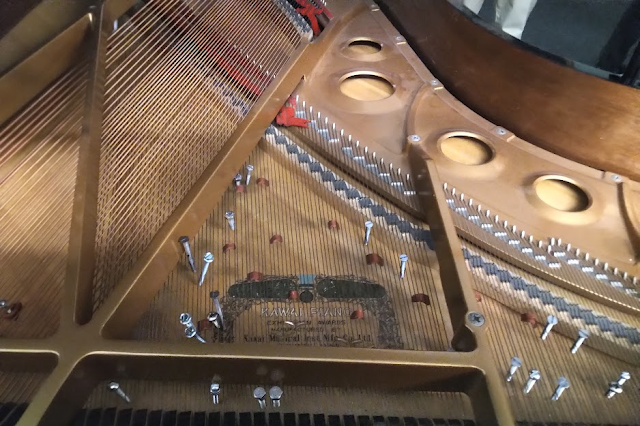
I’m
not really sure anyone can love 4’33” by John Cage, but that period of
silence gained a round of applause when Adam Johnson (no, not that one)
“performed” it during a Friday lunchtime recital at the Lit and Phil as part of
the Newcastle Festival of Jazz and Improvised Music (NFJIM)
on the last day of September. I’d taken a half day holiday to see this, my only
experience of NFJIM ever, as Johnson, blessed with enormous feet and attired in
a Geisha style dressing gown, was performing excerpts from Cage’s Sonatas
and Interludes for Prepared Piano. If I’m honest, I wasn’t sure what to
expect, but hoped that it would be something a bit silly. It certainly wasn’t.
It was piano turned into a percussion instrument, or even a set of gongs and
bells, that would have been ideal as part of a gamelan orchestra and Johnson,
who explained it took well over 2 hours to set up a prepared piano and has been
playing this piece for over 15 years, gave an effortless, virtuoso performance
that left this classical music neophyte stunned by the breadth of time sequences
and impact of tonality on the audience. I thoroughly enjoyed this and would in
the future to hear someone perform pieces by Cornelius Cardew, another of my
modern classical heroes.

BOOKS:
If
I wanted to make a football analogy about the autumn’s big Scottish literary
clash, I’d probably say something like a startlingly inventive Aidrie
comprehensively outplayed a complacent, lacklustre Hibs, which is another way of
saying David Keenan’s superb Industry of Magic and Light, the loose
prequel to This is Memorial Device, is a far better read than Irvine
Welsh’s formulaic The Long Knives, the latest unrealistic dysfunctional
polis procedural to feature Ray Lennox, the sidekick from Filth who got
his own vehicle in Crime. A key to the supposed worth of this latest
Welsh tome is his injudicious comments in interviews that The Long Knives
is a kind of necessary plot device linking Crime to next year’s
concluding Lennox novel. In other words, I’ve lashed out £18 and ploughed
through 400 pages just so a Lothian cop can hand in his notice and move
south.
We
get all the usual Welsh tropes here; the kind of racist and sexist bullshit his
baddies have spouted by the yard for a quarter of a century, as well as dollops
of sectarian football attitudes, though I am on his side when he insists that
true evil is to be found among the environs of Tynecastle. His unhealthy
obsession with anal sex is a persistent stain on the narrative, which features
the usual battery of seedy characters from earlier works, as well as equal
numbers of cartoon wrong’uns and unidimensional goodies appearing for the
first, and sometimes last, time in his fiction. It isn’t a bad read, but it
isn’t a great book. Then again, has he written anything memorable since Glue
or, at a push, Skagboys?
Unlike
Welsh, David Keenan never stays in his comfort zone, as has been demonstrated
by the massive, eclectic jumps in subject matter from This is Memorial
Device, to For the Good Times, Xstabeth and, most challenging of
all, Monument Maker; 400 pages down with 350 still to go, it sits
stubbornly on my bedside cabinet as the foundation stone of my yet-to-read
pile. Thankfully, partly because of a return to the familiar territory of
bleakest Lanarkshire and partly because of a return to narrative-based fiction,
rather than recondite theosophical musings that have oft left me cold, I was
able to race through this one in double quick time. I love the idea of Airdrie
being a kind of low-rent Haight Astbury mixed with Greenwich Village, where
Avant Garde creativity, hallucinogenic drugs and a strong seam of counter
culture sensibility make the place a vital, if hidden, jewel in Scotland’s
alternate history. When he’s on form, Keenan makes you believe the world he
describes is real and not created. You devour the pages, looking for clues and
explanations for madcap events from equally mad unreliable narrators trying to
recall incidents half a century ago through the refracted lens of a drug-addled
and broken memory. I love it.

Perhaps
the only work I’ve read recently that is of equal merit as Keenan’s, is the
impossibly talented Jim Gibson’s stunning debut collection, The Bygones.
Having known Jim for a decade as an editor of and contributor to publications
such as Hand Job and Low Life, as well as having the honour of
publishing him in glove, I have long seen him as an especial, eccentric
talent. Writing from a geographically precise blasted heath somewhere in the
ex-minefields of the East Midlands, Jim does enough to assuage that area of the
guilt of their conduct in the 1984 strike and the subsequent formation of the
home for scabrous scabs, the UDM, by showing us the place is possessed; mad,
deranged, bleeding with the running sores of evil that disfigure the landscape.
The Bygones, from its disturbingly beautiful front cover onwards, tells
tales of ordinary madness. Poverty, drink, drugs, mental and physical
ill-health, bad housing and endless, grinding poverty are the touchstones of
the madness in Jim’s area. In short, The Bygones comprises a stunning
set of nightmarish slices of grim, gruesome reality that read like a terrifying
docudrama about a real life dystopia. The stories hit home because of the
credible and crushing mundanity depicted on every page. This is absolutely
outstanding work. I can't recommend it highly enough.
Elsewhere,
I quite enjoyed The Persistence of Memory by Martin Cooper, who I’ve met
a couple of times through cricket. The book was given to me by our mutual
friend Di Brown and it tells a compelling and credible love story of outsiders
in Newcastle, from Germany and London, finding romance to replace the tragic
emptiness in their souls. Set from 2005 general election day until the 7th
of July bombings at Kings Cross and Tavistock Square, a seemingly improbable
narrative is held together by excellent depiction of characters. I read on
because I cared. Martin should be proud of this work, and I wish it was more
readily available so more people could appreciate how much he has put into the
book.
Finally,
another one of my Lit & Phil bargain books was Sally Belfrage’s
unintentionally nostalgic The Crack: A Belfast Year. The fact this year
was 1985 to 1986, which was my final year as an undergraduate in County Derry,
makes it all the more compelling for me as my idetic memory means I remembered
all the salient details. Like most people of sound mind, Sally arrived in the
Six Counties with an open mind, met people from both communities and left a
raging Republican. I can fully understand where she was coming from. Of course,
it is hopelessly out of date following the events of the intervening period,
but a superbly written vignette of yet another shameful period under Thatcher’s
police state.
There
are a few music books to read before we’re next here: Gavin Butt’s history of
the Leeds post-punk agitprop scene, No Machos or Pop Stars, Steve
Pringle’s guide to every Fall album, You Must Get Them All, as well as a
couple of trips north of the border in the shape of Stuart Braithwaite’s
autobiographical account of Mogwai’s life and times, Spaceships over Glasgow
as well as Douglas McIntyre and Grant McPhee’s encyclopaedia of Scottish punk
and post punk, Hungry Beat. I can’t wait to get dug in to that lot. I
might even finish Monument Maker while I’m at it…


