Tuesday, 24 February 2015

Extreme Folk Terror ; 2015 Music 1

Everything that follows has possibly been rendered irrelevant by the news that Godspeed You! Black Emperor are releasing a new album on March 31st, but let’s do our best to keep calm in the meantime…


If you’re looking for someone to blame for what I’m about to tell you, then Alex Neilson of Trembling Bells is an appropriate scapegoat. Not content with being drummer, vocalist and chief songwriter with the finest contemporary folk psychedelic outfit in the known world, the Yorkshire Glaswegian has also formed two other outfits that have markedly influenced my musical tastes over the last few months, sending my aural curiosities spiralling towards hitherto unknown territories. Firstly, he arrived at the Bridge Hotel last August with his “balls to the wall” Free Jazz outfit Death Shanties and split my head open with the immense noise they created. Consequently, I’ve been out and investigated what this genre means these days, courtesy of Viennese Theremin terrorists Blueblut, as well as a couple of Sun Ra and his Arkestra recordings found amid the smouldering stock embers of the late, lamented Volcanic Tongue Records, where Alex was once employed I believe. 

However, Free Jazz tells only half the story. At the very end of 2014, the final album I bought last year was by Alex’s other vehicle, the unaccompanied vocal group Crying Lion, which includes Trembling Bells’ genius vocalist Lavinia Blackwell, who released the stunning “The Golden Boat,” which simply blew me away in every possible way. Logging on to Facebook to pass this praise on, I was given an automated suggestion to like Topic Records (http://www.topicrecords.co.uk/), who for 75 years have kept the flame burning for Cecil Sharp and ethnomusicologists everywhere, with innumerable folk releases that are for people who hear little difference between the work of Kate Rusby and Lady Gaga. As a kid, I remember my Uncle Brian giving my dad a Topic release as a birthday present; the scratched and beaten up album “Canny Newcassel,” including Ed Pickford, Johnny Handle, Louis Killen and Bob Davenport among others (of whom more later) passed into my possession after my dad’s death and it’s a good nostalgic listen, including Tyneside songs from the mid-19th century onwards.

The thing was, while listening to Crying Lion, on vinyl wonderfully enough, I was able to read around the subject and what became clear to me, apart from the fact I needed to plug huge gaps in my musical knowledge about 60s folk music, was that Topic Records were a company I needed to spend time learning about. Well, after a few hours playing around on their website and various social media platforms, I found myself having purchased or borrowed CDs and vinyl by the following artists (in alphabetical order): Anne Briggs, Peter Bellamy, Shirley Collins, The Copper Family, Bob Davenport and Louis Killen, who have provided me with various levels of enjoyment and the opportunity to sing lustily and atonally along with.


For me, the most breath-taking talents from that list are the amazing, uncompromising releases by obstinate hedonist Anne Briggs and doomed, Bohemian traditionalist Peter Bellamy. Born in Nottingham and orphaned as a child, Briggs left home to sing in folk clubs in London when barely 16. Possessing a voice that only Sandy Denny or Lavinia Blackwell could hold a candle to, she sought the primacy of art above all else, eschewing commercial success or even regular recordings, while living an itinerant lifestyle, including much time in Ireland with Johnny Moynihan of Sweeney’s Men (incidentally, I’m immensely looking forward to Andy Irvine at the Tyneside Irish on April 16th). The CD I purchased of her greatest moments has stunning versions of “Polly Vaughan,” “Blackwaterside” and “She Moved through the Fair” that have actually improved my life by hearing them. As I say, she is part of a trinity of divine female voices alongside Sandy and Lavinia; that is the highest praise I can offer. I borrowed this CD from my mate Ginger Dave and returned it; he said subsequently I could keep it. I must get it back from him soon.


Poor Peter Bellamy killed himself back in 1991, convinced his life had been a commercial and artistic failure. The photo of him I have used here is one that shows him utterly ecstatic while singing; it’s the one I like best as I find his death such a tragedy. As yet, despite Alex’s recommendations, I haven’t as yet come across Bellamy’s first recordings with the Young Tradition, a group he formed after Anne Briggs urged him to drop out of Art College. Following YT’s disintegration after a few years, Bellamy followed a solo career as, in his own self-deprecating phrase, “a boring, bleating traddy.” This is totally unfair, as his “Both Sides Then” album is another stunning release, featuring Dave Swarbrick on some tracks, with Bellamy on accordion or unaccompanied on others. The opening “Barbaree” is a glorious, rollicking reading and one that almost makes me wish to punch the air. “The Housecarpenter” is a saddening story of tragic love, while “Derry Gaol,” also known as “The Streets of Derry” when Andy Irvine and Paul Brady do it, is even better than Sarah Makem’s supposedly definitive version. Bellamy’s tragic death should not overshadow the true genius of his work and I must find out some Young Tradition material soon.


Of a far more cheerful stamp are The Copper Family. Hailing from Rottingdean in Sussex, several generations of the family have sang joyous numbers of English rural life for pushing 150 years. First commented on by Kate Lee (a friend of Sir Edward Carson no less!!) in 1898, they were recorded in the early 50s for the “Come Write Me Down” CD, though at the time it was basically the BBC increasing their archives of a supposedly dying tradition. The four voices on that album, brothers  John and Jim Copper and their sons Ron and Bob, are all dead, but the joyous celebration of harvesting, spring and ordinary rural pleasures hint at a kind of pre Christian almost Pagan simplicity. Of course Fairport did a superb version of “Banks of the Sweet Primeroses,” but it is glorious to hear it unaccompanied, as well as Steeleye Span’s hit “Hard Times of Old England.” Also to be recommended is the celebratory “When Spring Comes In.” As someone who always scorned the optimistic nature of much English folk when compared to Irish folk politics, this is a refreshing change. I’m also delighted to see The Copper Family still continue with grandchildren and great grandchildren of John and Jim performing for the midwinter solstice in Rottingdean.

Also from Sussex is Shirley Collins, who with her sister Dolly accompanying her on portable pump organ,  was also an integral part of the 60s English Folk revival. However, I have to say she comes a very poor second to Anne Briggs in terms of female vocalists being, for my tastes, too formal and emotionless. Also, she lacks the warmth of The Copper Family and sounds as a little sullen for my tastes. Perhaps she’s too English for me. Actually, she reminds me of Rose West impersonating Maddy Prior.

Sadly, I also didn’t particularly enjoy Bob Davenport’s 70th birthday CD, “The Common Stone,” although I’m pleased to hear “The Bold Fenian Men” sung by someone with a broad Geordie accent, which does justify much of my post-closing time oratory these past 30 years I suppose.  Davenport was born in Gateshead, but headed off to London aged around 20 and ran folk clubs all around the capital, though all I knew of him was that he introduced Fairport to “The Hexhamshire Lass” which unfortunately doesn’t appear here on a set where arrogance drips from every pore, in my opinion.  It’s not a CD I will return to.

Another Tyneside born person who ran folk clubs was Louis Killen, who started the Bridge Hotel folk club in the late 50s/early 60s. As a young man, my dad sang with Luke Kelly of The Dubliners, who gave his first public performance in that bar. If only I’d asked him more about this before he died. Killen came from a Geordie Irish family and eventually moved to the States, where he joined The Clancy Brothers in the 1970s and 1980s, returning home to retire, passing away 5 years ago.  Recorded on Topic, found on vinyl for £2 at Tynemouth market one Sunday in January, “Along the Coaly Tyne” is patchy to these ears. I find much of the mannered excessively Geordie voices too histrionic for my tastes; certainly the overwrought version of “The Trimdon Grange Explosion” is far inferior to either Martin Carthy or The Mekons’ versions. However, I suppose it is good to have a local artefact as important as this.

Since I’ve signed up to Topic’s monthly newsletter, I’ve established a wishlist that includes The McPeake Family, The Watersons and, of course, Seamus Ennis, though the great thing about Topic, rather like dropping into Listen Ear records in Newcastle in 1978 and asking to hear the latest Rough Trade or Small Wonder release, is that unexpected suggestions appear and take you in hitherto unimagined directions. Hence, I have 3 hours of unaccompanied Sean-Nos singing by Joe Heaney (more properly Seosamh Ó hÉanaí) as his CD was February’s bargain of the month. Sticking his unknown name into google, I came across a live version of “Rocks of Bawn” (sadly not on this record) and was immediately struck by my need to purchase this. While 3 hours of Sean-Nos is pretty hard going there are some gems; “Skibereen,” “Bean Phaidin,” “The Valley of Kockanure,” “The Bogs of Shanaheever,” “Claudy Banks” and “Lonely Woods of Upton” in particular.

It also whetted my appetite to find out more about the whole idea of Sean-Nos and I’m determined to get hold of something by Darach Ó Catháin, or Dudley Kane as his family in Leeds knew him. Whatever you call him, “Oró 'sé Do Bheatha Abhaile” is stunning; incredible.  Not only that, but I learned of the incredible Irish art of lilting; literally diddly-dee-ing along to music, or instead of music. Seamus Fay from County Cavan is apparently the best exponent of it, so watch out for more here. I think I’ll be searching on Gael-Linn records rather than Topic’s website for these though.


One new CD I did get hold is Fairport’s “Myths and Heroes,” which I collected at The Sage at this year’s Wintour gathering. What an enjoyable evening it was as ever; I was particularly pleased that we didn’t get a greatest hits how, as it showed the band remain creative and vital, with Chris Leslie’s hair getting longer every year. Admittedly, things started with “Sir Patrick Spens” and finished with a trio of “Farewell! Farewell!” “Matty Groves” and, of course, “Meet on the Ledge,” but there were 9 tracks from the new album and several cuts from “The Festival Bell.” This can only be a good thing. The new album isn’t, of course, “Liege and Lief” or “Unhalfbricking,” but there are some great numbers, particularly “John Condon,” which could be a successor to “Red and Gold” in terms of mood and structure, “Bring Me Back My Feathers” and “Weightless.”

It’s rather ironic that the first new release I get in 2015 is from a band who have been together nearly 50 years, though sometimes old bands rehashing old stuff works just as well. The night before they played the Sage, Fairport played Leeds Grand; I was in town that night, but at a very different gig. Back in 1985, I thought The Jesus and Mary Chain were the future of rock and roll; for a while they were, until they learned to play, bought proper instruments and became dull Velvets and Stooges copyists, but “Psychocandy” and the early singles, including “ Sidewalking,” were glorious. That said, I wouldn’t have been bothered about seeing them again, especially as they played Newcastle the same night as Fairport so that was out of the question, but Ben insisted. Who was I to deny the bairn a proper musical education? I got us tickets and headed down on a half term Tuesday. Typically he was full of flu and had to drag himself out of his sick bed, but the show had to go on.


I’m delighted I went; white noise feedback, white light strobes and the same three chords for the slow ones and the same 2 power chords for the fast ones. Jim Reid draped over the microphone, William Reid spherical (who says black is slimming?) and an audience of middle aged men in leather jackets. What can you say though? “Just Like Honey,” “Some Candy Talking,” “Never Understand” and “Upside Down” were amazing. Obviously playing the whole of “Psychocandy” in order reduced the surprises, but it allowed Ben to last as long as “You Trip Me Up” before illness forced our departure 2 songs early. A taxi home for him and I headed to The Skyrack, my bar of choice back in 87, with ringing ears and nobody to discuss the gig with. I thoroughly enjoyed it and would recommend you see them. However, if they’re doing “Automatic” or “Honey’s Dead” next year, I won’t be back.

As far as forthcoming releases, other than GY!BE, I’m looking forward to stuff by The Gang of Four, The Pop Group and Wire, not to mention British Sea Power’s “Sea of Brass” and Francis MacDonald, which will no doubt feature in my next music blog. All of which are encouraging signs that old bands are releasing new material, though I’m slightly disappointed not to have seen The Pop Group or Wave Pictures (I also missed out on getting a ticket for them on February 7th at The Cumberland, when it sold out while I prevaricated) or even The Fall. You see, those three bands, as well as Mogwai on the Friday supported by Sleator Kinney, were announced as part of the Radio 6 Festival in Newcastle.  The first night’s tickets, 1,800 of them at the Academy, sold out before I’d even heard about the festival. As regards Saturday night, while The Fall were playing, I’ve seen them often enough not to be bothered about paying £35 to see them support  Hot Chip and Maximo Park, so I got myself ready for the Sunday; Wire and British Sea Power.

Despite mentions of Saturday’s tickets going quickly, I was amazed to see 3,400 Sunday tickets disappear in 30 seconds. Seriously; less than a minute for them all to go. What was worse is that they all ended up on Stubhub and Viagogo at massively inflated prices.  Frankly I was both furious and heartbroken, with a growing sense of disgust when the free Saturday day time tickets (The Pop Group and Wave Pictures), which were supposedly available by lottery, didn’t go to anyone I knew. Not one person I was acquainted with was successful. The BBC seriously needs to look at their policy of using licensed scalpers like See Tickets to distribute tickets. The only results I see are pissed off punters who have lost faith in the best radio station there is, not to mention the immaculate box office of The Sage being forced to suffer undeserved flak from those who missed out. That said, when I was ready to pretend the whole event wasn’t even taking place, a kind friend of a friend on Facebook offered me cost price for the Sunday and it was marvellous.

Heading to The Sage on a bone-chilling Sunday, with incessant sleet driving in from the west, I wasn’t in a great mood. However, once inside, everything ran like clockwork. Radio 6 ought to be commended for the superb organisation of the festival and picking a load of bands that wouldn’t sell out individually but came together effectively and made for a great night. That said, I was back indoors by 9.00 to see Laura snivelling at “Call the Midwife.” Actually, that’s a good idea for gig timings in future.

Entering The Sage around 5.15, I saw a few people I knew, passed on the beers and got a place 2 from the front in Hall 1 for British Sea Power. Bang on time, Steve Lamacq introduced them and, with no time to waste, they flew through a crowd pleasing half a dozen numbers, with “Waving Flags,” “The Great Skua” and “All In It” really bringing the house down, especially when Ursos Actos appeared, much to the consternation of neophytes in the crowd. Compared to the staid Sea of Brass show in October, this was brilliant and really brought home to me how much I love this band and everything they stand for. Simply superb entertainment.


From Hall 1, I shuffled along the balcony and down the stairs while King Creosote finished playing. There was plenty bars, beer sellers and food stalls, but I was only interested in seeing Wire. After King Creosote, the crowd moved on and I secured a place right at the front in time for one of the most important bands I’ve ever heard. They did not disappoint; “Doubles and Trebles” and “Joust and Jostle” were the stand out numbers in a furious, visceral aural assault. Never in their nigh on 40 year history have Wire contemplated compromise. This is still the case and, I’m delighted to say, many said they stole the show. They were the end of my show and I don’t regret paying £40 to see 2 bands or hear 12 songs. Did you really expect me to stay for Tim Burgess and The Charlatans?

As regards live music, while I’ve tickets for Lee “Scratch” Perry on April 10th and Andy Irvine the week after, the one gig I’m now tempted by is Wire at Brudenell Social Club on Tuesday April 28th; I’m determined to make it there and back in a night.


Monday, 16 February 2015

The Second Coming....

I'm off to Leeds this week, to see the Jesus & Mary Chain with Ben. They're playing Newcastle the night after, but I'm off to see Fairport Convention that night. Next week's blog will probably be a music one as I've not put one up yet in 2015. Anyway, last time I went down to visit Ben in Leeds, I went to see Doncaster Rovers 0 MK Dons 0; this is something I penned about it that is in the latest issue of Donny's great fanzine "Popular Stand" -:


The first time I was in Doncaster was Tuesday 18th August 1992, when I made my only visit to Belle Vue to see Rovers lose 3-0 to Lincoln City in a League Cup first round, first leg tie. I believe my team Newcastle played a preseason friendly at Doncaster in either 92 or 93, but both times I was on holiday, so my only experience of a Rovers game was that one. In all honesty, I remember nothing about it, other than the ease of Lincoln’s win.

Fast forward to 24th October 2014, I headed from Newcastle to Leeds, where my son is student, to take him to see the reformed, belligerently magnificent Pop Group at Brudenell Social Club, 35 years since I last saw them. Next morning, being of the opinion that any Saturday afternoon without football is a Saturday wasted, I decided to watch Doncaster Rovers at home to MK Dons. Leeds city centre was absolutely teeming with expectant fans. I felt pity for them as I eased aboard the almost deserted 13.05 to Kings Cross.  It would be fair to say I was one of the very few who got off that train at Doncaster to head for the game.

I took a bus up to the ground, which had a few MK Dons fans on it. Bearing in mind these blokes were, at the outside, mid 20s, the chances are the only team they’ve watched regularly in their life are the side still known as Franchise FC in some quarters. Frankly, to have such a dismissive attitude towards fellow fans strikes me as unnecessarily confrontational absolutism; these people simply want to watch their local team. That said, the witless droning of approximately 200 Buckinghamshironians through a predictable litany of “you’re not very good “and “shall we sing a song for you?” in flattened quasi estuary English tones was exceptionally grating.


We’ll not bother talking about the game shall we? The fact the found as much as 12 seconds of highlights on The Football League Show astonished me. However, in all seriousness, you’ve got a lovely ground; if I could design a new football ground, I think the Keepmoat would be the blueprint I’d base it on.  Great access in and out of the ground, good signposting, plenty of facilities (decent coffee I must say) and helpful stewards who guided me to the correct car park for the bus back to town. I’m disappointed not to have seen James Coppinger as I actually remembered his only appearance for NUFC (won 2-0 home to Spurs in August 2000); mind I’m also disappointed I didn’t see any goals. In conclusion, I had a great day and wish you and your club well for the future.

Wednesday, 11 February 2015

Undefeated

Issue 6 of "The Popular Side" is out now (£2 inc P&P or £1 for PDF via PayPal to iancusack@blueyonder.co.uk). Feedback has been uniformly positive, though a quisling quartet who haven't read it (presumably the same ones who struggled to follow the think about North Shields fans the other week) have started a pitiful whispering campaign against the publication, which is rather amusing... Anyway, here's my article from issue 6; hope you enjoy it and if you don't enjoy it, at least you can understand it....

T.S. Eliot was wrong; April isn’t the cruellest month, January is. Just look at the fortunes of Newcastle United in the opening weeks of 2015: inactive in the transfer window, disinclined to appoint a permanent successor for Pards and displaying our trademark indifferent form on the pitch, whereby the only chance we deluded Geordies had to jump for joy was that wholly undeserved point at home to Burnley on New Year’s Day. We’ll not even mention the annual FA Cup third round surrender away to Leicester, or the fact that the squad was rewarded for securing the requisite abject defeat at the earliest opportunity with a week’s warm weather training in Dubai. This is the banal, depressing reality of life under Mike Ashley.

Let’s look on the bright side eh? While the players enjoyed their sporting sinecure among the beautiful dentists of the UAE, supporters were left to kick over the bones of a dismal 2-1 home loss to Southampton and speculate that the future promises no better as the U21s, as we must now call the Reserves, went down at home to Blackburn Rovers the Tuesday after. Bookending these two games were a pair of meetings that should have been of interest to all followers of Newcastle United who seek to do more about the state of our club than simply whine and grumble about the owner on a variety of social media platforms.

On Thursday 15th January, the vibrant and inclusive independent supporters network NUFC Fans United (@NUFCFansUtd), created out of frustration with the inert and ineffectual Newcastle United Supporters’ Trust (NUST), hosted a meeting at the Tyneside Irish Centre on Gallowgate where the keynote speaker was David Goldblatt, academic, football fan and author of Game of Our Lives: The Cultural Politics of English Football, which is the first essential book I’ve read in 2015. Those who filled the upstairs concert room on a bitterly cold evening were rewarded with an inspirational talk, whereby David outlined a draft manifesto for footballing change, demonstrating the cause and effect of the rotten core of our national game, the inability of current legislation and legislators to actively challenge these problems and a series of suggestions, both practical and theoretical, that could help us to reclaim football for the people who really matter; the fans. I’m sure the details of the manifesto will emerge soon, but suffice to say, no-one who cares about the game can fail to respond to suggestions that ticket pricing, the match day experience, especially as an away fan, institutional racism, chronic underfunding of the grassroots game, the refusal of many clubs to pay all employees a living wage and the lack of effective regulation of clubs, owners and supporters’ trusts, need thorough examination and, in several instances, legal intervention.

As part of a fact finding tour to take the temperature among committed activists up and down the country, David had already hosted a gathering in London before Christmas in conjunction with Stand fanzine and, having flown up at his own expense (we did treat him to a curry in Café Spice on Chilli Road afterwards though), was off to Manchester the day after to attend a similar event, with meetings in other cities in the pipeline. The purpose of David’s visit was to listen, to learn and refine the 11 point manifesto that will hopefully, in advance of the May election, provide a coherent document to encourage politicians to think seriously about our national game. For more than 2 hours, debate was maintained on a wide range of issues with supporters, not just us lot but those of Middlesbrough and Hull City, a pair of whom had driven 120 miles to be there. Everyone present was able to contribute positive suggestions in an atmosphere of mutual support and admiration. As the meeting drew to a close, NUFC Fans United resolved to work hard to ensure that this appetite for structural change is channeled positively, by holding future monthly planning meetings for the purpose of organizing an event related to the launch of the manifesto at a game in April. The Popular Side is fully behind this and will give any meeting or event maximum publicity, both in print and on Twitter. 

On Wednesday 21st January, NUST held its Annual General Meeting at The Mining Institute on Neville Street. Created by the storm of righteous supporter anger at the disgraceful treatment of Kevin Keegan in 2008, it seems to me that NUST has subsequently lost its campaigning zeal and stagnated to the point of ossification from 2010 onwards, to the extent that the wider support, if they even recognise its continued existence, view the Trust with either indifference or disdain verging on contempt. At the meeting, there were no apologies asked for or taken and only those NUST board members who spoke announced their names; consequently I am unsure exactly how many members of the elected 12 member NUST board were actually present, but certainly several were inexplicably absent. In addition there was no representative in attendance from either the Football Supporters Federation or Supporters Direct. If there had been, one wonders exactly how they would have reacted to the unequivocal announcement by one member of the NUST board that “public meetings don’t work.” This statement was not a point for discussion; it was presented as a desperately depressing fact. Frankly I find the suggestion that a supporters’ trust would no longer seek to provide a platform for all fans to attend and give their opinions quite staggering and another reason why, as much as owners and boards of directors should be subject to regulation as to their activities, we need the regulation of supporter organisations. If NUST were an effective vehicle for fan interaction and representation, there would be no need for NUFC Fans United to exist.

I do accept that supporters’ trusts are to an extent hampered and hidebound by their constitutional requirements, but NUST’s future plans for contact with members by inviting a select few to attend board meetings or to hold “surgeries” seemed to me akin to the activities of a constituency Labour Party in the 1980s; regulations, rules and procedure being more important than activism. The irony being that during the 46 minute AGM, several NUST board members recognised the need for campaigns about ticket pricing and the need to pay a living wage, not to mention calling for an agreed national political strategy in advance of the election. Unfortunately the seemingly endless round of committee meetings with other trusts will no doubt result in any enthusiasm being squeezed out of a project that should run in conjunction with the visionary work of David Goldblatt that will undoubtedly empower and inspire fans across the whole country.

I make no bones about the fact I feel that the attempt to ride the zeitgeist of spontaneous fan activism as espoused by David Goldblatt has far more chance of capturing the imagination than the meticulous paper-shuffling of supporters’ trusts. However, here is a reality check. NUFC Fans United attracted 31 to the David Goldblatt talk-in and the NUFC Trust AGM was attended by 23 of the 769 fully paid-up members. Meanwhile, 49,307 watched the Southampton game and even 509 frozen human peas rattled round the St James Park pod for the Under 21s game. That is what we are up against; the seeming indifference, cynicism and despair of 99% of NUFC supporters. The choice is clear; we either throw our hands up in despair or we grit our teeth and redouble our efforts to take the argument for greater fan involvement and better regulation of the game to all supporters. As far as I’m concerned, the matter isn’t up for debate. We don’t despair; we can’t despair. We must keep on fighting!


Friday, 6 February 2015

Why I love Non League Football..

Last week's post from "The Football Pink" has garnered me the highest number of views in a week since this time last year. I'd like to think it's because so many people agreed with me; sadly it appears it's because so many people can't actually understand written English. That said, those who matter were highly appreciative; I'm grateful. So, as tomorrow is FA Vase last 16 day, here's a piece of why I love non league football, which appeared on the website for Jim Gibson's fabulous LitZine Handjob, which I recommend you buy immediately from http://handjobzine.com/tag/litzine/ Anyway, here's my piece; best of luck to every team playing tomorrow. Just a shame Benfield are inactive -:


Newcastle United are my professional football team. Being born and brought up on Tyneside, a love for the Magpies was in my blood from birth I suppose, though the first time I got to see them was aged 8 and a bit on January 1st 1973; a 2-2 draw with Leicester City in the only game played in England that day, as New Year’s Day wasn’t a Public Holiday until 1974. I remember nothing of the game and, with no cameras present; I’ve never seen any footage of it. However, from those early years of blind adoration, I still have programmes, ticket stubs (for big games only; most of the time you paid on the gate) and newspaper cuttings. This collection of memorabilia stops abruptly in autumn 1983, when I headed off to university. I disappeared to County Derry on the day Peter Beardsley signed and returned, via wanderings to London and Leeds, in summer 1988 when Paul Gascoigne was sold. As an act of idiotic blind faith, I ignored the departure of the team’s best player and lashed out on a season ticket, then proceeded to watch from the comfort of R41 in the newly built Milburn Stand as we were relegated during the following season. That didn’t really matter to me; I was 25, solvent and able to travel up and down the country attending games, which we generally lost. 

Watching NUFC was almost automatic, as was adding a second season ticket for my dad when he retired in 1994 and a third for my son when he was old enough in 2003.  This pattern continued until summer 2009; Newcastle were relegated then, but my dad’s death on 1st August (the day after Bobby Robson passed) and my son’s decision to concentrate on playing rugby on Saturdays rather than watching football, meant I stopped going to St James’ Park. It was a blessed relief. These days, I couldn’t envisage attending St James Park on a regular basis (though I’m always up for a spare ticket), as despite having a good job, I simply couldn’t afford £600 per year for a season ticket.
From around 1995 onwards, I’ve actively disliked professional football to the extent that now I view not only the players, the media camp followers, the corporate lickarses but the unthinking, bovine mass of supporters, mainly those fucking idiots in replica shirts on bar stools and sofas who refer to unimaginably rich sportsmen with the same kind of fake intimacy (“delighted to see Frank playing for City” or “Stevie G deserved to win just one title” – FUCK OFF) that Royalists reserve for the parasitic Windsor clan, with a kind of mocking contempt I find impossible to disguise. This may be seen as disingenuous as I edit a Newcastle United fanzine, The Popular Side (@PopularSideZine),  but I take inspiration from Richard Ingrams who, when appointed TV critic of The Oldie didn’t possess a television. I don’t need to see it to know it is immoral.

If almost everything that is wrong with society today can be traced to the era of evil ushered in when Britain became a Police State under that bastard Thatcher in May 1979, then a similar charge can be pressed against The Premier League and Sky TV, for their collective rewriting of the social history of a game that began among the mid Victorian bourgeoisie, but was soon claimed as the rightful property of the industrial working classes from the late 19th Century onwards. Football did not begin in 1992; it began to lose credibility at that point. Being honest, from a personal point of view, the 1992/1993 season when Newcastle stormed to the Division 1 title and the 1993/1994 campaign when we finished third on our debut in the Premier League were great; football fairytales in fact. The problem came the season after when the media circus, expectations of fans, sheer amount of money involved and inflated rhetoric of all concerned with the game meant it all began to mean too much. Victories were overly celebrated, defeats sparked a period of mourning and draws were ruthlessly analysed to find greater significance than the bland stalemate deserved.  I could no longer take the hyperbole associated with the professional game seriously. The best thing for me was the number of free Saturdays because of games being shifted to Sky TV.

I’ve always played football, back then on a Sunday morning for The Blue Bell in the Tyneside Sunday League and now for Wallsend Winstons in the North East Over 40s League (we won the double last year; read about it here http://payaso-de-mierda.blogspot.co.uk/2014/05/oldplay.html), but I’d never really followed the amateur Saturday game. Then, I read the best book about football ever; The Far Corner by Harry Pearson, which is a loving history of the game in the north east, which mostly focusses on The Northern League, an amateur competition that has been in continuous existence since 1889. On reading this fabulous book, the scales fell from my eyes and I spent every spare Saturday touring the north east, from Northallerton in the south to Alnwick in the north and across to Penrith in the west, visiting all the clubs. It was a joy to see players giving their all for £10 a match and to experience the integral nature of teams to their local communities. Admittedly the crowds weren’t large (“like Church, there’s few here and most over 60,” as Harry observed), the games often brutal and the weather generally appalling, but I fell in love with it, floating like a peripatetic groundhopper but developing a strong affection for my local side Benfield of Northern League Division 1.

In 2009, when I retired from Newcastle United, I was 45; I knew that the older I got, the quieter I needed my pubs of choice to be, the smaller the gigs I attended and the more intimate my football experience. I decided, having been persuaded to get involved by my mate Norman who was their secretary, to throw in my lot with Percy Main Amateurs of the Northern Alliance Division 1; a team who were 8 straight promotions from the football league and play at Purvis Park in North Shields. It was a dream season; we won the divisional cup, got promoted and I wrote a book about it called Village Voice (which you can have for £2 via PayPal to iancusack@blueyonder.co.uk). 

The great thing about non-league, which may also be a weakness to obsessives, is that the game is the thing; losses are borne philosophically and victories accepted gracefully. Also, sometimes bonds with clubs can loosen. On the committee at Percy Main, there were half a dozen of us and it was hard graft keeping the place in good order, which didn’t play to my strengths. After about 4 years, I realised I’m no odd job man and more of a wordsmith, so when Benfield asked me to edit their programme, I changed allegiances, as I was honoured to accept the challenge from a club I’d followed since learning of the rich heritage of the grassroots game, and find myself immersed in the task of producing a quality memento of a game, that costs £1 but is only printed in quantities of 50; that doesn’t matter, as what I want to do is to give spectators a decent keepsake from their visit to Sam Smith’s Park.

On Saturday 31st January 2015, I saw my 31st successive Saturday afternoon game of the 2014/2015 season. After a wintery blast on the Friday night had decimated the local fixture list, with Benfield’s trip to Dunston falling by the wayside, I was still able to attend West Allotment Celtic 2 Billingham Synthonia 1. Admission was £5 and hot drinks 60p, so regardless of the quality, we did not feel deceived or defrauded by the whole experience. The game was fairly terrible, with both sides in the bottom 5 of Northern League Division 1, the day was perishing and the crowd was 100 maximum, but it was a great afternoon in the company of several mates, all of whom had jacked in tickets at St James Park, sickened by the hype, the greed and the excess of the professional game. We hardly mentioned Newcastle’s earlier 3-0 win at Hull, talking instead of Benfield 4 Durham city 1 the week previous and the upcoming North Shields v Phoenix Sports FA Vase tie.


The wonderful, obscure 1960s itinerant folk singer Anne Briggs, whose voice is the equal if not superior to Sandy Denny’s, talks of how her experiences and travels across Scotland and Ireland with traditional musicians were the greatest education she had in her life and how the existence of The Beatles and The rolling Stones was something she was aware of, but utterly detached from; that’s as good a metaphor for my love of non-league football as I can imagine.  If the Premier League is the bearded DJ hipster in pointy shoes squeezing sounds out of a laptop in an exposed brick craft ale bar, then non-league football is the fella with the Arran sweater playing the mandolin at a folk club in CAMRA’s pub of the year. It may not be pretty, it certainly isn’t to everyone’s taste, but I bet you our version of “Blackwaterside” is more authentic than his.


Sunday, 1 February 2015

The Lord of the Flies

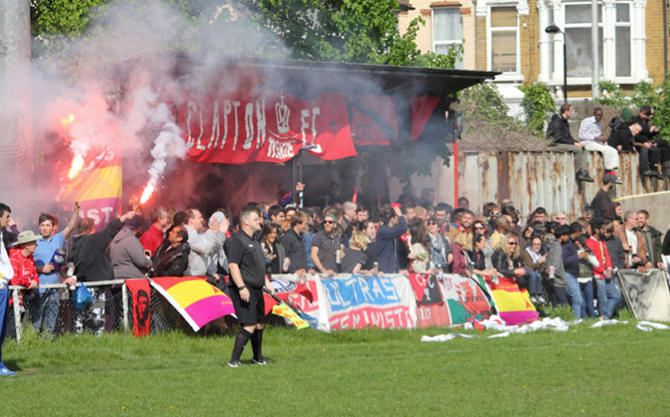
Apparently, down in The Smoke there's a new phenomenon; the non-league hipster. Most often seen by the appearance of Ultras at Clapton and Dulwich Hamlet, they're bringing pointy shoes and beards into the grassroots game. Next Saturday sees North Shields take on Phoenix Sports in the last 16 of the FA Vase. Shields have a squad of Ultras, but I think they're slightly at variance from the ones at Champion Hill and the Spotted Dog, for cultural and economic reasons, as I tried to explain in this piece from issue 7 of "The Football Pink" -:


I’ve got this mate down in the Smoke, well more of an acquaintance really; Irish bloke by the name of Sean. He’s into left wing politics and a community activist, working as a research fellow in the Department of International Relations at Queen Mary College out on the Mile End Road.  Despite completing his doctorate in the quiet of Galway, Sean quickly made himself at home in the intense East End a decade or so back. He’s no intentions of ever moving back, having accumulated the accoutrements of modern life in the shape of a good job, a significant other, an affordable mortgage, not to mention a grand social life boasting a dazzling array of craft ale bars, obscure bands and DJs, a plethora of restaurants and even a football team to support. Sean will admit to having grown up with more of an interest in My Bloody Valentine and Slowdive than sport, though his dad and brothers are still part of the County Wicklow branch of the Arsenal Supporters Club; he’s been to the Gunners with them in the past, but Leyton Orient are his team, or at least that’s how it stands at the present.

Less than 15 minutes’ walk from Sean’s house is the fabulously named Old Spotted Dog Ground, which has been the home of Essex Senior League outfit Clapton FC since 1888. Attending at the prompting of friends, colleague and comrades, and having seen the Ton win consecutive home games over Sawbridgeworth Town and Hullbridge Sports, Sean has fallen in love with the amateur game, to the extent that his season ticket at Brisbane Road is under threat. However, it’s not so much the football as the ambience that has turned his head, as Clapton along with their south London comrades Dulwich Hamlet, about who Martin Cloake wrote so eloquently in The Football Pink, are at the forefront of a loose amalgam of dilettante hipsters attending grassroots games in the capital, whose motto is utterly irreproachable:  Football for all. Good times, good songs and Polish lager. Always antifascist. Watching Clapton and, to a lesser extent Dulwich Hamlet, is to involve yourself in a rapidly-evolving fan culture, that is the UK prototype of the FC Sankt Pauli supporter model that only the estimable FC United of Manchester have come anywhere near emulating in the past. Or that’s how Sean explains it. I have to say that I am massively excited to hear about these developments in London and have put them, along with a trip to Broadhurst Park in Moston when it finally opens, at the top of my agenda for future fraternal visits.


If you expect me, a north east non-league devotee, with more than quarter of a century’s service on the wind-ravaged terraces of the Northern League and the mud-encrusted fronds of the Northern Alliance, to look down my nose at the pointy-shoed, bearded, bourgeois arrivistes at Clapton, then you’re wrong. From my years of being involved with clubs like Percy Main Amateurs and Newcastle Benfield, and the Tyneside Amateur League at an administrative level, I know that pragmatism not purity will always win the day; clubs don’t care who wanders up to the turnstile, they just desperately need money to help keep them afloat, despite any potential drawbacks that may accompany an exponential growth in support. While I have only a vague inkling of what is taking place at Clapton and Dulwich, it is my belief that the social conditions and the culture surrounding non-league football in the north east make it unlikely that such phenomena will be repeated in my neck of the woods. Demographics play their part as well; there aren’t huge numbers of post-modern ironists educated to higher degree level beating a path to the door of the Northern League, though there are always the odd gang of thirsty nutters on the lookout for a new hobby.

Take for instance Ashington; in 1994 the club was struggling at the foot of Northern League Division 2 and were on the verge of closure. A desperate call for support among the local community saw crowds, boosted by many who were either locked out of Keegan era St James’ Park or inspired by the rise in popularity of the game in general; grow from less than 20 to almost 200. Cups were won and promotion achieved, while the bandwagon rolled ominously onwards, downhill without any brakes, when the club decided to move from their historic, former Football League ground Portland Park, to a purpose built flat pack amenity on the edge of town. Their support, revelling in ostentatious drunkenness, often attired in face-paint, curly nylon wigs, foam hands and replica strips, weren’t bad lads, but they often behaved badly; boorishness during the presentation when they lost a League Cup final in 2004 and disorder at the last night at Portland Park in 2008 (crowd 1,945) were particularly unpleasant incidents. However, circumstances dictated the move from Portland Park was their last hurrah; the new, antiseptic Hirst Welfare ground saw a haemorrhaging of support. Currently they draw crowds of 150 or so, with their away support’s conduct similar to almost every other team in the league; a couple of car loads of shivering middle aged blokes in winter coats, drinking Bovril and taking the mickey out of proceedings. The daft lads and lasses of a decade back are nowhere to be seen.

To a large extent, the evolution of a club’s support at a non-league level can be as much to do with chance as anything else; witness how mid-table Northern League Division 2 side Heaton Stannington, alongside the usual collection of locals and former players, have about a dozen newly-converted, zealous fans, none of whom will see their 50th birthday again, who knew each other previously through the informal networks of the 1977-influenced, anarcho-punk revivalist scene. Their appreciation of bands from The Addicts to Zoundz gives a sense of cohesion and shared purpose vital for maintaining both enthusiasm and motivation when things aren’t going too well on the pitch, not to mention a club programme that includes adverts for gigs and records that wouldn’t have looked out of place in Sniffin’ Glue. While The Stan may not have huge potential for supporter growth, two other clubs, Marske United and North Shields, have seen an astonishing growth in their fan base over the past season or two, which while ostensibly being a cause for celebration, is also a potential reason for alarm.

The biggest Northern League club on Tyneside should be Whitley Bay on account of: 4 FA Vase wins, including 3 in a row from 2009, a superb ground at Hillheads, a squad of talented players and two other crucial factors; the club is located in the most affluent part of North Tyneside and the anti-Ashley sentiment among many Newcastle fans that saw average crowds pushing 500 only a few years back. However, the Bay failed to harness this potential and it seems the ship of opportunity has sailed. Their team languishes in lower mid-table, two managers have left, the support is in open revolt over the gloomy hanging over the club and this season has seen dreadful home defeats; 0-5 to Shildon, 0-7 to Marske and 2-4 (0-4 at half time) to North Shields. For the latter game, the crowd was 859, of which perhaps 500 were visiting fans, many of whom had earlier “taken over” the nearby Foxhunters pub, as if this was a professional fixture, which was reinforced by the minor pitch invasion after the opening goal, the incessant chanting and the massive array of flags. Despite the second half recovery, this game (rather than the Marske massacre) was the most shameful of all defeats for the Bay and marked a seismic shift in the balance of non-league power north of the Tyne. Consequently, Shields versus Marske on January 3rd was shaping up to be a beguiling encounter, on and off the pitch.

Marske United come from the relatively isolated border of Teesside and North Yorkshire, where Middlesbrough are the nearest league team whose mundane travails (prior to Karanka’s arrival) saw apathy rule. As a result, Mount Pleasant has seen the organic growth of the Chicken Run Ultras, a gang of teenage lads whose idea of fun is to attend Northern League games and sing Soccer Am style ditties in support of their team. Against my side, Benfield, about 30 of them made the trip, where they sang a few songs and lustily celebrated a late equaliser in a 3-3, but didn’t upset anyone. When North Shields came to Benfield, there were 300 of them and they marched up from The Railway in Walkergate like something from Green Street.  At Whitley Bay, the Saturday before Christmas, 60 Marske lads congregated under the tin shed and went ballistic from start to finish, banging on the roof and exploiting the echo as their team rattled in the goals. Whitley’s middle-class and middle-aged support grimaced and tolerated the noise, in a way they’d indulge a teenage son learning to play the drums. You see, Marske aren’t North Shields.

The day Benfield played Marske I popped into town for a pint at full time with friends who’d been to Newcastle v Leicester. Taking the Metro home about 9, I noticed the presence of a dozen or so absolutely bladdered radgies about my age, attired in immaculate Stone Island and Burberry casual threads. They sang an array of Loyalist numbers, including the whole of “The Sash” the entire way home. They hadn’t been to Ibrox, where the NE29 UVF flag that was waved up and down the carriage would have fitted right in, they’d been to Penrith, to watch a Northern League game; supporting North Shields.

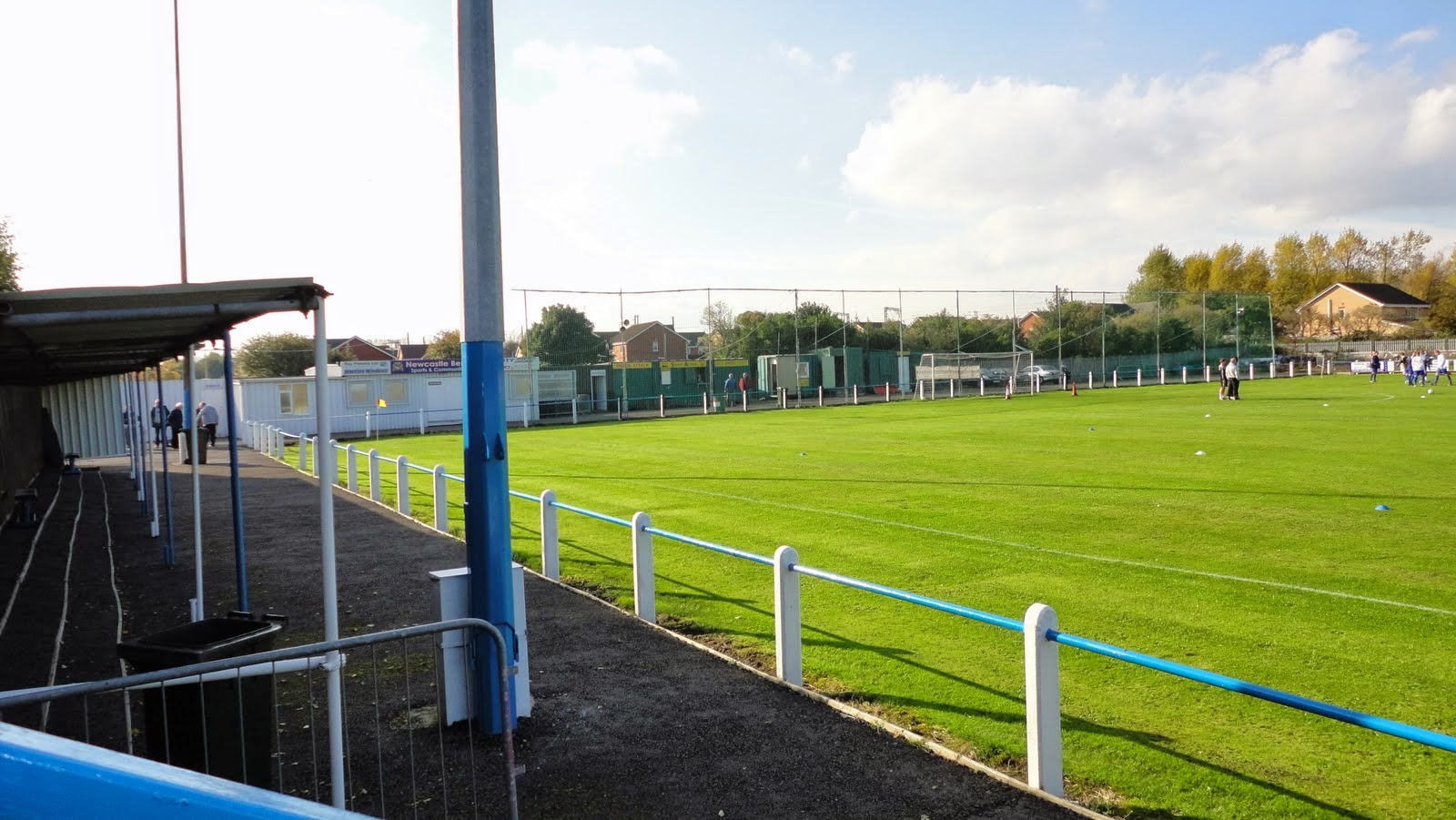
If you want the yin to Clapton’s yang, meet the North Shields Ultras. Shields is a crazy town; a former fishing port with an endemic culture of heavy drinking, soft and hard drug use and every single indicator of social deprivation you can imagine turned up to 11. This is a town of hard men who hate authority with a passion; they literally do what they want. There may be anarchists at Clapton and Heaton Stan, but they can’t hold a candle to the Shields lot, certainly in terms of terrace attire. Blokes who turned their back on the professional game when either the sold out signs went up at SJP in the early 90s or when Northumbria Police served them with banning orders, preferring instead to drink and brood, burst back on the scene when their club (which underwent almost 25 years in the wilderness after selling their former Appleby Park home) emerged from the wilderness to win Northern League Division 2 in 2014, attracting 1,312 to the title winning game against West Allotment Celtic. Cycling to Shields v Marske, I went past the Spring Gardens pub and saw upwards of 100 casuals in the car park singing songs about their love of Shields. In the Northern League, where the noise of players arguing with officials generally drowns out the sound of spectators moaning about the game, such atmosphere is a rare occurrence.

With Ashington previously and with Marske and Shields now, the sheer novelty of the size of their support allows the self-styled Ultras to assume the importance of their existence is far out of proportion to their numbers. As they don’t meet any other sets of fans who want to fight or argue with them, they believe they can do what they want. It’s almost like Lord of the Flies, where the absence of a defined external set of absolute moral values causes those at the centre to create their own parameters, which may be unacceptable to others. However, in many cases, these others aren’t the majority when Marske or Shields turn up; helping to perpetuate the mythologies the Ultras create about themselves. Personally, I’m not offended by swearing or drunkenness at a non-league game, though some may be; I’m offended by a UVF flag at a Northern League game, but I’m not going to ask the assembled Shields Ultras to take it down, as a nuanced debate on politics in the north of Ireland is probably unlikely in the context of non-league football.


Of course, I may be unduly pessimistic; Marske walloped Shields 4-0 in front of 452 and there wasn’t a cross word exchanged between the two sets of fans. Perhaps the Whitley away game, like Ashington’s last match at Portland Park, was the pinnacle of North Shields Ultra culture. Perhaps normality will soon be restored. Only time will tell. Similarly, only time will tell whether Sean stays with Orient or throws in his lot with the Clapton Ultras, until they supernova.


When that happens, he can join me at Sam Smith’s Park, drinking Bovril and moaning about the linesman; it’s what supporting a non-league team, whether it be Benfield or Dulwich Hamlet, is generally about.

Thursday, 22 January 2015

The Bald Prima Donnas


I know this isn’t one of my cultural blogs, which tend to get about 10% of the audience my football related pieces get, but I’d like to start off with a review of a book; David Goldblatt’s Game of Our Lives: The Cultural Politics of English Football, which is the first essential thing I’ve read in 2015. Goldblatt is an academic, football fan and author, who combines a clear left wing sociological perspective (though avoiding the mendacious opportunism of avaricious Trotskyites) with a deep and abiding love for Tottenham Hotspur and an adopted affection for Bristol Rovers. As a teaching academic, he is aware of the importance of lucid prose and a strong authorial voice, where the ideological viewpoint is crystal clear. He manages this with aplomb and his book is consequently both a joy and an inspiration; nowhere else could I imagine nodding in furious agreement with relentless haranguing of all that is wrong with the game, while simultaneously finding myself wrapt with nostalgic joy at anecdotes and asides about the history and culture of the game, which encapsulates both the past, the present and the potential future of all aspects of the game. He may not namecheck every one of the 92 league clubs by name, but he comes damn close, showing his learning lightly and effortlessly throughout the whole book. I urge every one of you to go out and read this book; you will not regret it and hopefully you will be as inspired by the contents as I was.

I’m very aware of appointing the equivalent of a fans’ Pied Piper, but Goldblatt is nothing like that; he’s a democrat and of unimpeachable moral probity. He doesn’t want to be a fans’ leader; he is simply blessed with an intelligence and articulacy that enables him to vocalise what so many of us instinctively feel, but may struggle to phrase effectively. Before Christmas I was contacted by Tom Reed of Stand fanzine, asking if I could attend a meeting in Crouch End at the end of November about fan engagement, which David was chairing. It was a non-starter for many reasons, mainly to do with work, but David was encouraged enough by discussions with Tom and me to suggest a similar meeting on Tyneside early in 2015, charging me with the responsibility of organising it. This is where things became difficult. In the past, I’ve made literary allusions to Samuel Beckett, Franz Kafka, David Peace and Berthold Brecht in pieces about Newcastle United. This time, I think we’re talking Eugene Ionesco’s theatre of the absurd.

Under which organisation’s name could the event take place? Obviously there’s the Newcastle United Supporter’s Trust (NUST), of which I am a member and whose AGM was scheduled for 21st January. The major problem with NUST, an organisation created by the storm of righteous supporter anger at the disgraceful treatment of Kevin Keegan in 2008, it seems to me, is that NUST has subsequently lost its campaigning zeal and stagnated to the point of ossification from 2010 onwards, to the extent that the wider support, if they even recognise its continued existence, view the Trust with either indifference or disdain verging on contempt. If they were not seen as a fit vehicle for such a meeting, and I would privately doubt if the politics and personalities involved with NUST at the board level would countenance involvement with anything I suggested, then who?

The only viable answer was the vibrant and inclusive independent supporters network NUFC Fans United (@NUFCFansUtd), created in 2012 out of frustration with the inert and ineffectual NUST, who still have a permanent seat on the official NUFC Fans’ forum, unlike NUST of course, who got themselves kicked off for breaching protocol after the first meeting. We’re going over ancient history now, so suffice to say that after last year’s NUST AGM, where the elected board promised more openness and engagement with the membership, NUFC Fans United took a step back from organising events to give NUST a chance to redeem themselves. We gave them the rope, but they couldn’t be bothered to either corral some new members or hang themselves trying.

In 2014, following NUFC Fans United’s policy decision to take a step back from organising meetings, NUST had a chance of really pushing on with 3 newly elected board members: Graeme Cansdale and Ciaran Donaghy, who I know to be lifelong Newcastle United fans, and Michael Martin, who edited the magazine True Faith when it existed in print form and I now believe runs their website. However, 2014 was not a good year for NUST as far as I can see. Since their last AGM, NUST have overseen the farcical and confusing 69 minute walk-out against Cardiff that was ignored by 90% of the crowd and hosted a pre-match meeting with Ian Mearns MP and Mary Glindon MP, who are personal friends of members of NUFC Fans United anyway, of which nothing more was heard. This was the day of the Hull City game, so at least it wasn’t the most notable fiasco that afternoon; the Sack Pardew demonstration (dear oh dear…) breasting the tape in triumphant fashion in that race to the bottom. In praise of NUST, they launched a credit union which may be of help for those in serious financial difficulties, though I don’t know the details of that branch of their activities.

Meanwhile, members of NUFC Fans United continued to represent supporters on the Fans’ Forum and launched the wildly successful Popular Side fanzine, which produced 5 issues between August and late December, as well as keeping cordial relations with the whole panoply of Newcastle United supporters. This involved attending the pre Derby do in The Bridge Hotel that was organised by the Football Supporters Federation, which is an organisation I have little time for, not least because of its willingness to accept money in the form of sponsorship for its annual awards from William Hill bookmakers. The FSF’s dauphin Michael Brunskill took an almighty strop with me when I wrote a piece about this in issue 11 Stand (http://payaso-de-mierda.blogspot.co.uk/2015/01/another-hill-of-beans.html), but that wasn’t the reason I chose not to attend their soiree in The Bridge; Whitley Bay versus North Shields had my undivided attention that night. And more of that next week, if I’ve not been silenced by then…  

Despite all the brouhaha about Newcastle United striking a sponsorship deal with Wonga, some people seemed only too pleased to bask in the reflected glow of the publicity afforded by  the FSF annual awards. I know for certain at The Popular Side we’d have had nothing to do with a business that exploits human weakness and greed, but not everyone has our moral standards. We’re comfortable in our own skin and don’t need to feel vindicated by a bookie sponsored ego massage. However, if you don’t win, try not to get too upset. Certainly that could explain the stories of crass rudeness towards Lee Marshall, the NUFC Supporters’ Liaison Officer and a very personable young man whom I’m delighted to call an acquaintance. I mean, I wasn’t there, but to try and reach out and understand what they were going through, perhaps the disappointment affected their natural bonhomie.  Seriously though, I feel heartily sorry for Lee because of what he endured that night, but I have to say he’s not the only one to get it in the neck from NUST board members, whatever (sun)hat they are wearing.

Let’s face it; some people don’t like Mike Ashley. Some people think it’s acceptable to bracket every NUFC employee alongside the owner and treat them abominably. Some people think it’s acceptable to reprint private emails without permission. Some people don’t like The Popular Side. Some people, amazingly enough, don’t like me. All of those things are acceptable in theory; certainly none of them are hanging offences, even breaching acceptable boundaries of confidentiality with emails. However, as an ordinary member of NUST in good standing, I wonder just where the line is to be drawn regarding acceptable conduct by elected board members towards ordinary members. I also wonder just what can the ordinary member do to voice his criticisms of the direction chosen by a supporters’ trust.

Of course I recognise fans fall out with each other all the time; modern life is like a series of smartphone playground spats. For goodness sake, just look at the cyber casual brotherhood who tore each other asunder in the autumn because Grandmaster Sash was proving himself to be more interested in profit than being a prophet. There were people wearing Odor Eaters in place of poppies at the Real Estate gig at the end of October, in memory of all the young men who’d fallen in senseless slaughter on social media. I’m sure they’ve got over it by now; some are still on the moral high ground and others are laughing all the way to the bank. That’s how it goes, but we’re talking about the elected members of a supporters’ trust here, not an on-line Tufty Club.

I realise that many complex and insecure people find themselves in public life and struggle to cope with criticism of their (in)actions. Highly strung and easily led, wracked with self-doubt, these weak characters often seek the company of supposedly strong male figures of authority, who can grant them the reassurance they need, whether these authority figures they flock to have instrumental power, such as club chairmen or other elected representatives, or influential power, by being overly aggressive, alpha male gang leaders. In addition there appears to be a certain strata of volunteer bureaucrats, often to be found in the Trotskyist blind alley of left wing politics, obsessed by notions of their own infallibility, who luxuriate in power, but struggle with ordinary social interaction. Perhaps it is part of their DNA, I don’t know, I’m no medical professional; or perhaps they gain the kudos they crave by acting out the role of the unblinking tyrant with a clip board, ruling willingly obsequious underlings with a rod of iron. Whether such roles are adopted out of conscious or unconscious psychological need, or whether there is an acknowledged element of implied homoeroticism, I do not know. I’m almost frightened to peek beneath that Freudian rock and see the bugs clinging to the surface.

Steve Hastie tells the hilarious story of the Cardiff City trust board member worried that his organisation, designed to fight back against the Tan regime (well done on getting the shirt colour reversed by the way), was being high jacked by members of the Soul Crew who simply wanted to have the away fans moved next to the home end for ease of pre and post-match paggers. Hilarious and frightening, but that’s democracy. Before realising that NUST as an organisation was institutionally inert, a number of us countenanced a simplified Trotskyist policy of entrism to take it over and try to make it a suitable vehicle for campaigning by winning the elections. On reflection we abandoned the idea as not worth the effort, but if we’d been successful, that wouldn’t have been a coup d’etat, it would have been democracy. Just because you don’t like the message, you can’t stifle freedom of speech; there is no such thing as a semi democracy.

However I do wonder where NUST is headed, when I consider the pair of meetings that should have been of interest to all followers of Newcastle United who seek to do more about the state of our club than simply whine and grumble about the owner on a variety of social media platforms, that I attended in the last week.


On Thursday 15th January, NUFC Fans United hosted a meeting, Fan Inclusion: Waiting for the Great Leap Forward, at the Tyneside Irish Centre where the keynote speaker was David Goldblatt. Those who filled the upstairs concert room on a bitterly cold evening were rewarded with an inspirational talk, whereby David outlined a draft manifesto for footballing change, outlining the cause and effect of the rotten core of our national game, the inability of current legislation and legislators to actively challenge these problems and a series of suggestions, both practical and theoretical, that could help us to reclaim football for the people who really matter; the fans. I’m sure the details of the manifesto will emerge soon, but suffice to say, no-one who cares about the game can fail to respond to suggestions that ticket pricing, the match day experience, especially as an away fan, institutional racism, chronic underfunding of the grassroots, the refusal of many clubs to pay all employees a living wage and the lack of effective regulation of clubs, owners and supporters’ trusts, need thorough examination and, in several instances, legal intervention.

As part of a fact finding tour to take the temperature among committed activists up and down the country, David had already hosted a gathering in London before Christmas in conjunction with Stand fanzine and, having flown up at his own expense (we did treat him to a curry in Café Spice on Chilli Road afterwards though), was off to Manchester the day after to attend a similar event, with meetings in other cities in the pipeline. The purpose of David’s visit was to listen, to learn and refine the 11 point manifesto that will hopefully, in advance of the May election, provide a coherent document to encourage politicians to think seriously about our national game. For more than 2 hours, debate was maintained on a wide range of issues with supporters, not just us lot but those of Middlesbrough and Hull City, a pair of whom had driven 120 miles to be there. Everyone present was able to contribute positive suggestions in an atmosphere of mutual support and admiration. As the meeting drew to a close, NUFC Fans United resolved to work hard to ensure that this appetite for structural change is channeled positively, by holding future monthly planning meetings for the purpose of organizing an event related to the launch of the manifesto at a game in April. The Popular Side is fully behind this and will give any meeting or event maximum publicity in print and on Twitter. 

On Wednesday 21st January, NUST held its Annual General Meeting at The Mining Institute by Central Station. At the meeting, there were no apologies asked for or taken and only those NUST board members who spoke announced their names; consequently I am unsure exactly how many members of the elected 12 member NUST board were actually present, but certainly several were inexplicably absent, such as Ciaran Donaghy and Mark Jensen. In addition there was no representative in attendance from either the Football Supporters Federation or Supporters Direct. If there had been, one wonders exactly how they would have reacted to the unequivocal announcement by one member of the NUST board that “public meetings don’t work.” This statement was not a point for discussion; it was presented as a desperately depressing fact. Frankly I find the suggestion that a supporters’ trust would no longer seek to provide a platform for all fans to attend and give their opinions quite staggering and another reason why, as much as owners and boards of directors should be subject to regulation as to their activities, we need the regulation of supporter organisations. Currently, there is no effective regulation of supporters’ trusts; if there were, would NUST still be banned from the NUFC Fans’ Forum? Who knows? However, the plain truth is that if NUST were an effective vehicle for fan interaction and representation, there would be no need for NUFC Fans United to exist.

Simply, I do accept that supporters’ trusts are to an extent hampered and hidebound by their constitutional requirements, but NUST’s future plans for contact with members by inviting a select few to attend board meetings or to hold “surgeries” seemed to me akin to the activities of a constituency Labour Party in the 1980s; regulations, rules and procedure being more important than activism. The irony being that during the 46 minute AGM, several NUST board members recognised the need for campaigns about ticket pricing and the need to pay a living wage, not to mention calling for an agreed national political strategy in advance of the election. Unfortunately the endless round of committee meetings with other trusts will no doubt result in any enthusiasm being squeezed out of a project that should run in conjunction with the visionary work of David Goldblatt that will undoubtedly empower and inspire fans across the whole country.

I make no bones about the fact I feel that the attempt to ride the zeitgeist of spontaneous fan activism as espoused by David Goldblatt has far more chance of capturing the imagination than the meticulous paper-shuffling of supporters’ trusts. However, here is a reality check. NUFC Fans United attracted 31 to the David Goldblatt talk-in and the NUFC Trust AGM was attended by 23 of the 769 fully paid-up members. Meanwhile, 49,307 watched the Southampton game and even 509 frozen human peas rattled round the St James Park pod for the Under 21s game. That is what we are up against; the seeming indifference, cynicism and despair of 99% of NUFC supporters. The choice is clear; we either throw our hands up in despair or we grit our teeth and redouble our efforts to take the argument for greater fan involvement and better regulation of the game to all fans. As far as I’m concerned, the matter isn’t up for debate. We don’t despair; we can’t despair. We must keep on fighting!

Finally, I will always renew my NUST membership each year...

Tuesday, 13 January 2015

Another Hill of Beans

This Thursday (January 15th), NUFC Fans United are hosting a meeting at Tyneside Irish Centre featuring the academic and author David Goldblatt, about the next steps forward in fan involvement and engagement in the modern game. Sadly NUFC supporter politics means a number of people will sulk and not attend; their loss. I'd imagine the FSF's dynastic dauphin Michael Brunskill won't be there as he's still in a strop with me after I posted the first version of this article, which appeared in "The Popular Side" #4 last December; http://payaso-de-mierda.blogspot.co.uk/2014/11/hill-of-beans.html. Well, here's the updated version that appears in Stand #11


I first wrote for Stand in issue 2, so having contributed to every edition bar 6 since then, I feel a strong bond of loyalty to this publication. Obviously I broadly agree with the overarching ethos that the magazine was established on and the subsequent refinements in current editorial policy, otherwise I wouldn’t still be here. To paraphrase Bobby Robson’s hackneyed homily; what is a fanzine anyway? Well, at the NUFC fanzine I co-founded, The Popular Side, we agreed we’d be an A5, old school, not for profit venture, without advertising, website or merchandising. We intend to stay that way; indeed, if we compromise on any of those principles, I’m out of there. If you want a musical analogy, The Popular Side are the mandolin-playing, finger-in-the-ear singers and clog dancing troupe supping Real Ale at a folk club, while bells and whistles on-line operators  like Stand are DJing with their iPads in their Norman Walsh trainers in a wooden floored and exposed brick Craft Ale emporium. Which approach is more in keeping with the spirit of fanzines? The answer, of course, is both, though I reckon our version of A Sailor’s Life sounds more like Sandy Denny’s than theirs does.

Each month when I do the mail-outs of The Popular Side, I also send fanzine PDFs (because this is a far cheaper method than posting out copies, as the costs incurred would mean we’d struggle to achieve our goal of breaking even on our small modest print run) to friends and allies in a growing band of other, inspirational publications with whom we feel a special bond as they’ve shown us that in this digital age, there is still a market for published fanzines: West Stand Bogs (Barnsley), Mudhutter (Wigan Athletic), All At Sea (Southend United), The Football Pink (general), Popular Stand (Doncaster Rovers) and Duck (Stoke City). These latter two publications, along with well-established titles such as United We Stand (Man United), The Square Ball (Leeds), A Love Supreme (sunderland) and, which is the point I’ve been leading up to, Stand have been shortlisted for the 2014 Football Supporters’ Federation (FSF) Fanzine of the Year Award. The FSF awards also include categories such as Player, Commentator, Writer and Pundit of the Year, so there’s a chance to further garland the likes of Sergio Aguero, John Champion, Henry Winter and Lee Dixon, reinforcing their roles as our lords and masters in the football arena. Results will be decided by an on-line poll, which will have been announced before Stand 11 appears.

Last year Stand won the title of Fanzine of the Year, but I have to say I was distinctly underwhelmed by this for two main reasons. Firstly, and coming from the era of late 70s music fanzines and loony left politics, I realise I may sound ludicrously anachronistic here, I’m more than a little uneasy with the concept of direct competition among fanzines; we should be celebrating our unity and common, shared goals and aspirations. As fans, rather than professional writers, we have enough to deal watching our teams compete with each other on the pitch, without trying to create an unnecessary, pretend meritocracy involving soi-disant supporter-led organisations that are funded, trained and emasculated by the game’s rulers. In my eyes, every supporter of every club, from Manchester City and Chelsea to the very base of the non-league pyramid, is of equal worth, as we are all in this together. Therefore, to attempt to try and impose a competitive edge to any independent, printed expressions of opinion seems to be contradictory to the founding principles of our own and every other fanzine. If you ask my opinion, Duck is a magnificent read, but I’m more than elated to note the existence of so many print fanzines, old and new.

Secondly, without even going into the question of the value and worth of the FSF, and this really sticks in my craw, the fanzine awards are sponsored by William Hill. Again, I realise I’m in a tiny minority here, but I don’t gamble. My personal choice is by the by in relation to these awards, but I have to say that I simply fail to understand how anyone can be up in arms about football clubs taking sponsorship money from pay day lenders like Wonga, without going into the question of gradated morality in relation to capitalism, when at the same time expressing no moral indignation at the involvement of bookmakers or, even worse, making plain their ruthlessly ambitious desire to win an award that has the name of a large chain of bookmakers plastered all over it.

Gambling addiction, whether it be on-line poker, roulette machines or the local dog track, is as much of a destructive influence on individuals and families, often in the poorest sections of our society across Britain as a whole, as alcohol or drugs. I’ve no statistics to back this up, only intuition, but I’d imagine that payday lenders (aka legalised loan sharks) are often the only source of credit for those who find themselves up to their eyes in debt because of failed punts on dogs, horses or cards. Surely, as independent publications providing a voice for disenfranchised and marginalised supporters, we should not be having any truck with multinational corporations that prey on human weakness and desperation? This is precisely why The Clash didn’t do Top of the Pops; once you become part of the mainstream, you can’t help but be tamed and controlled by the supporters and functionaries of The Man. I’d like to think that if The Popular Side had been offered a place on the list of nominees, we would have turned it down flat.

In all honesty, if you want to show support and give recognition to fanzines, go out and buy one. Most magazines have got a Twitter profile and accept PayPal; far better to pay a couple of quid and have an hour’s enjoyment out of it than pour more money into the pockets of super-rich corporations who’ve reached that spot out of exploiting all of us and are using these awards as a Trojan horse for increasing their profile among the very sorts of fans I would have hoped could see through the avaricious madness that has debased our sport.